 File no. 042
How Gen Z Inherited A Scam Economy
 Sergio Aoun
Essay, 1,871 words
In this essay
- And Nobody Warned You It Was Designed This Way
- What “Scam Economy” Actually Means
- GameStop: The Clearest Proof You Will Ever See
- NFTs: Paying Millions for a Screenshot
- WeWork and the Exit Model That Rewards Failure
- Prediction Markets: When Everything Becomes a Bet
- The Generation That Grew Up Inside It
- What You Can Actually Do About It
You Grew Up in the Scam Economy
And Nobody Warned You It Was Designed This Way
In 1720, even Isaac Newton lost a fortune. The South Sea Company had sold the British public a story about monopoly trade routes, slave commerce profits, and an empire’s backing, and the stock price climbed to 1,000 pounds per share, roughly equivalent to $200,000 to $300,000 today. When the bubble burst, the price cratered to 124, and financial ruin spread through the streets. Newton, who had already sold once at a profit, got back in near the top and lost the equivalent of several million pounds. His reported verdict: he could calculate the motions of the stars, but not the madness of men.
Three hundred years later, the madness has a Discover Page.
What “Scam Economy” Actually Means
Before you dismiss this as doomerism, understand what the term actually describes. It is not a conspiracy theory. It is a structural observation: at some point, the economy shifted from rewarding the production of real value to rewarding whoever could tell the most convincing story about future value.
When your grandfather bought shares in a railway company, he was literally financing the laying of tracks. The company built something, moved goods, made money, and paid dividends. Your return came from a really productive activity. The stock price tracked the business’s actual earnings. There was a direct, measurable connection between owning a share and owning a piece of something real.
That connection did not disappear overnight, but it has been stretched so thin in many cases that it barely exists. Today, a company can go public without ever turning a profit, at a valuation built entirely on projected future hype, and early insiders can walk away rich before the average investor figures out what happened. That is not capitalism malfunctioning. That is capitalism doing exactly what its current incentive structures reward.
GameStop: The Clearest Proof You Will Ever See
In January 2021, GameStop, a brick-and-mortar video game retailer that was losing relevance as digital downloads took over, became the most talked-about stock in the world. Hedge funds had shorted it heavily, with short interest exceeding 140% of the available float at one point. Traders on the Wall Street Bets subreddit coordinated a buying campaign that forced a short squeeze, sending the stock up more than 1,600% in a matter of weeks.
Nothing about GameStop’s actual business changed. The stores were still struggling. The fundamentals were still weak. The only thing that changed was the story, and the story was powerful enough to move billions of dollars. Short sellers lost over $3.3 billion on the trade in a matter of days. Some retail investors who got in early made real money. The majority who chased it later watched investors collectively lose $13.1 billion when the stock collapsed, a figure nearly double GameStop’s entire market capitalization at the time.
The lesson was not that retail investors can beat Wall Street. The lesson was that price and value had become completely unrelated. If you can convince enough people that a number is going to go up, it will. Until it doesn’t. And when it doesn’t, the people who started the story have usually already left.
NFTs: Paying Millions for a Screenshot
If GameStop was the textbook example, the Bored Ape Yacht Club was the abstract art installation in the same museum. In April 2021, Yuga Labs released 10,000 randomly generated cartoon ape images as non-fungible tokens. The price was driven entirely by what others were willing to pay, and celebrities began buying, posting, and promoting their apes to their audiences.
At the peak, the collection’s floor price hit 128 ETH. Justin Bieber paid the equivalent of $1.3 million for a single image. There was no cash flow. No utility. No productive asset of any kind. It was a status signal in an economy where digital status had started to feel like real currency.
By late 2022, Bieber’s ape had dropped to roughly $70,000, a 95% loss. By 2024, the collection had shed over 90% of its peak value, representing losses of approximately $3.27 billion across its 10,000 tokens. The NFT market as a whole entered what analysts called a trust crisis, with trading volumes collapsing and the loudest promoters going very quiet.
The structure was identical to the South Sea Company. Hype from credible-seeming authority figures. A story too exciting to question. And a floor that dropped out once the next story arrived.
WeWork and the Exit Model That Rewards Failure
The most revealing version of this pattern is the one where founders walk away rich even after catastrophic failure. WeWork is the case study that should be taught in every business school as a warning, not a success story.
At its peak in 2019, WeWork was valued at $47 billion based almost entirely on founder Adam Neumann’s ability to reframe office subleasing as a consciousness-expanding tech revolution. The business model was renting long-term leases and subletting them on a short-term basis, something that had existed for decades. The valuation was built on a story about “elevating the world’s consciousness.” When the IPO filing forced a look at the actual numbers, the valuation collapsed.
WeWork eventually filed for bankruptcy in 2023, its stock falling to 84 cents per share for a total valuation of $44.5 million, down from $47 billion. Adam Neumann, the man who drove it there, walked away with a reported $1.2 billion plus a $500 million credit line from SoftBank, which had pushed him out.
Uber’s story runs parallel. When it went public in 2019, it had lost over $8 billion that year and had never turned a profit. Early investors and insiders still cashed out billions at a valuation north of $70 billion. The game is not to build something sustainable. The game is to grow fast enough and tell a compelling enough story to sell at a higher price to the next buyer. You only lose if you are the last one holding it when the story ends.
Prediction Markets: When Everything Becomes a Bet
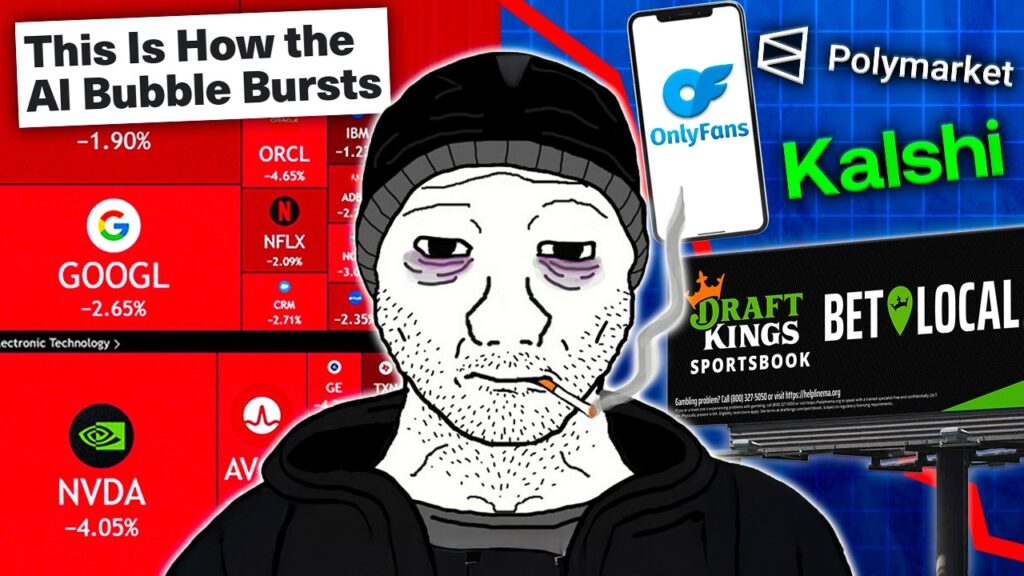
The logical endpoint of this trajectory is the gamblification of reality itself. Prediction markets are now a mainstream financial product. Kalshi and Polymarket together controlled 97.5% of the prediction market share in 2025, with Kalshi alone recording over $23.8 billion in notional trading volume, a year-over-year growth of more than 1,100%. Kalshi’s valuation reached $5 billion after winning a legal battle with the CFTC that cleared the way for expansion.
Tarek Mansour, Kalshi’s CEO, stated the long-term vision plainly: to financialize everything and create a tradable asset out of any difference of opinion. You can now place a bet on whether a particular TV host will say a politician’s name a certain number of times. You can trade contracts on soybean prices for a specific Thursday afternoon. The market’s own description of what it is doing is not hidden. It is the mission statement.
This is the scam economy in its final form. When the underlying question is no longer “does this create value?” but “can we make this tradable?”, the economy has become a casino that has convinced itself it is a stock exchange.
The Generation That Grew Up Inside It
Gen Z did not inherit a broken economy. They inherited one that was working exactly as designed for people upstream of them.
80% of Gen Z report feeling financially behind their life goals, according to Northwestern Mutual’s 2025 Planning & Progress Study. Nearly half of Gen Z adults report either struggling to meet basic needs or living paycheck to paycheck. 70% are so anxious about money that it disrupts their sleep. Over 50% say they are extremely worried about not having enough money.
And in that context of desperation, 32% of Gen Z have either already invested in or are actively considering investing in cryptocurrency. When traditional, conservative financial paths feel like they will never be enough to close the gap, high-risk speculation starts to seem rational. If the economy seems to reward catching something at the right time more than building something over a decade, that perception shapes behavior.
The meme stock phenomenon accelerated this. Research published in 2021 showed that around 4.5% of people who traded GameStop shares had opened brokerage accounts on or after January 13, 2021, the start of the mania, and these new investors were predominantly younger and less experienced than other traders. The market introduced itself to an entire generation through its most volatile and speculative moments.
When the only visible success stories are crypto overnight wins, meme-stock squeezes, and influencers pushing courses on passive income, the conclusion is understandable: the traditional path is for people who could not figure out the shortcut. This is a rational response to an irrational set of incentives, but it tends to end the same way the South Sea Company did for anyone who joined after the story was already old.
What You Can Actually Do About It
Individual action is not going to fix structural problems in the global economy. But individual action can stop you from being the easiest target inside those structural problems.
Put friction between you and speculation. Trading apps designed to look like games are built to keep you emotional and impulsive. Delete them or remove them from your home screen. The urgency they manufacture is a product feature, not a real signal. There is no opportunity you are missing. Most of that price movement is noise, and the more you react to it, the more you lose.
If you invest, make it boring on purpose. Broad index funds on an automated schedule, set and forgotten. This removes emotion from the equation entirely. Every piece of hype buying is designed to arouse your emotions because emotional decisions are fast, and in a trading environment, fast decisions almost always benefit whoever is on the other side of the trade.
Add a pause before every financial decision. Write down why you are buying something. What problem does it solve? Whether you would still want it if nobody else knew you had it. That 24-hour gap between the impulse and the action kills most bad decisions because the urgency you felt was manufactured and evaporates when there is nothing to feed it.
Audit your “opportunity content” diet. Any feed that constantly tells you about the next big thing, the thing you are missing, the move you need to make now, is an advertising environment dressed up as financial education. Limit it. The more time you spend consuming it, the more susceptible you become to the exact mechanisms that make the scam economy function.
Spend money and attention on things that create real value. Small businesses solving actual problems. Local services. Honest work. When you vote with your wallet against hype and toward substance, you shift incentives at the margin. It does not fix everything, but it makes you harder to farm and the machine slightly less efficient at scale.
The South Sea Company eventually collapsed. So did GameStop at $4 per share. So did the Bored Apes, and WeWork, and every other structure built on story without substance. The question is never whether the bubble will burst. The question is always whether you are still inside it when it does.
The most useful thing you can do is understand the game well enough that you stop being a player in someone else’s version of it.
■ Keep reading
More from the archive.



■ Notes from the Archive
Get the next essay by email.
One letter when a new essay is ready. No spam. Leave whenever you like.